
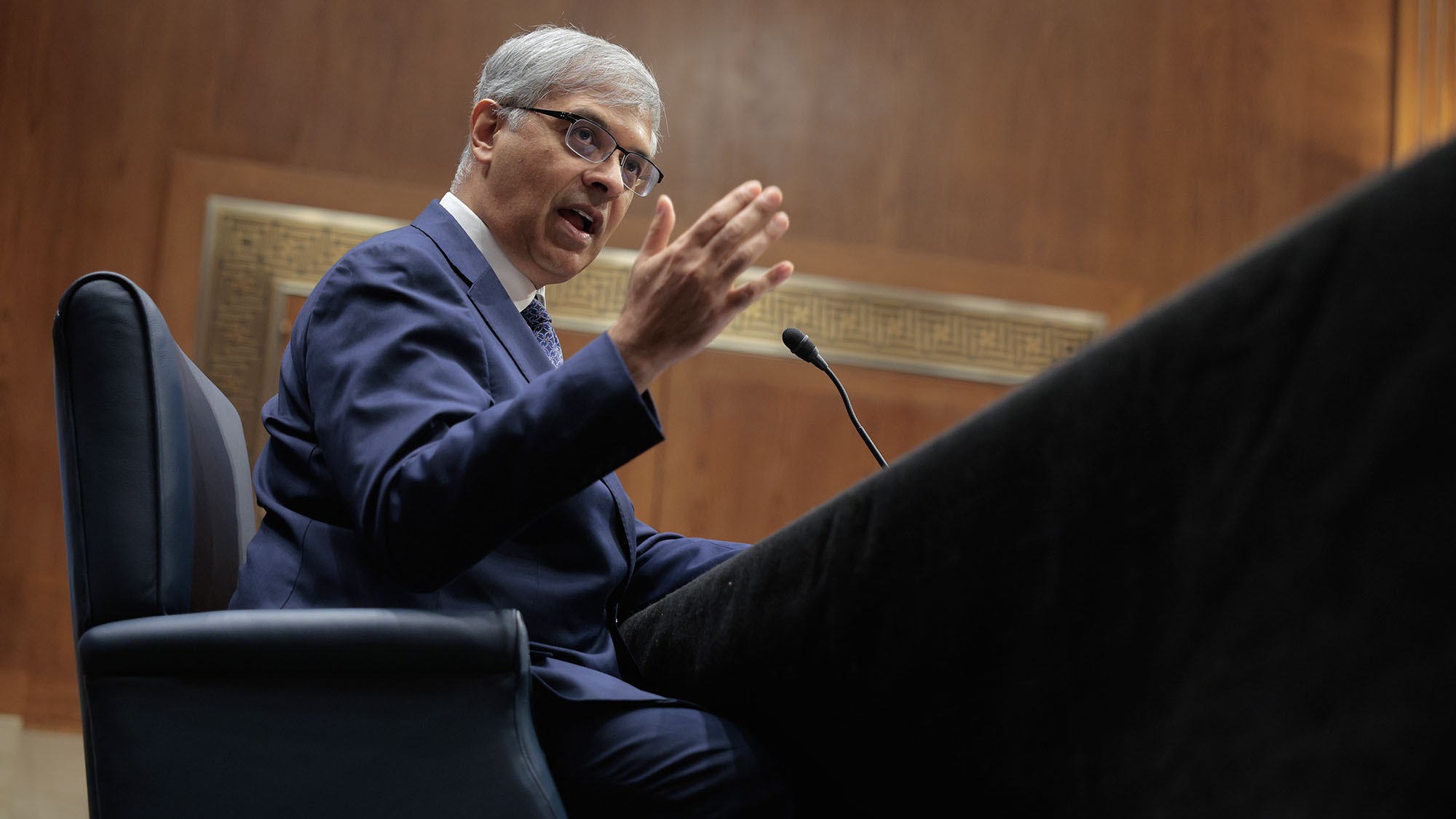
This time last year, Jay Bhattacharya’s main claim to fame was, in essence, a hot take on COVID. In 2020, Bhattacharya, then a health economist at Stanford University without specialized training in infectious disease, co-authored the Great Barrington Declaration, an open letter that downplayed the risk of COVID and called for most of society to reopen before the arrival of vaccines. Back then, health experts widely excoriated this laissez-faire approach as dangerous and ill-conceived; now Bhattacharya wields more power over the direction of U.S. health policy than most Americans ever have. When Donald Trump returned to office, he tapped Bhattacharya to lead the National Institutes of Health. And last month, Bhattacharya became the only person who has ever been tasked with directing the NIH and the Centers for Disease Control and Prevention at the same time.
As the acting director of the CDC, Bhattacharya’s tenure will likely be brief; Trump reportedly plans to name a new permanent director soon. But Bhattacharya clearly wants something from the agency. In his first email to CDC staff, he wrote that the federal government’s “decisions, communications, and processes” broke the public’s trust during the pandemic, and that “acknowledging this reality is a necessary step toward renewal.”
In practice, the CDC has been undergoing a kind of forced renewal for months. Since Robert F. Kennedy Jr. took over as the secretary of the Department of Health and Human Services, thousands of people have been pushed out of the CDC, and several prominent agency leaders have resigned their post. Last year, Kennedy also dismissed the entirety of the agency’s independent vaccine-advisory group, the Advisory Committee on Immunization Practices (ACIP), and replaced it with a more anti-vaccine cohort. Several of the CDC’s vaccine recommendations have been stripped down too—in many cases, “as far as they can go without affecting coverage guarantees” from insurers, Jason Schwartz, a vaccine-policy expert at Yale, told me. And the CDC has lacked a permanent leader since Susan Monarez, the most recent director, was abruptly ousted from her role last August. (Monarez asserts that she was forced out after she refused to rubber-stamp Kennedy’s restrictive and scientifically unfounded vaccine policies; Kennedy has contradicted this account, accused Monarez of lying, and said that she resigned after he pressed her on whether she was trustworthy.)
Bhattacharya himself remains steadfast in his pandemic-era views. More than five years after he first became a vocal opponent of COVID lockdowns, he continues to relitigate that position on podcasts, in interviews, and on social media. Lockdowns themselves might now be a moot policy point, but another of Bhattacharya’s pandemic sore spots, COVID vaccines, are still under active discussion at HHS.
For years, Bhattacharya has insisted that policies that pushed for widespread COVID vaccination violated “informed consent rights” and were “dangerous for public health.” He has disputed the abundant evidence that COVID vaccines are effective and safe. He has also argued that the continued investment in COVID shots has been a waste and that improving Americans’ baseline health is a better way to guard against future pandemics than stockpiling vaccines is.
In the lead-up to the midterms, Kennedy is reportedly nudging HHS away from attacking infectious-disease policy. But COVID vaccines, which are particularly unpopular among Trump’s Republican base, might still represent a politically palatable target, Dorit Reiss, a vaccine-law expert at UC Law San Francisco, told me. Several new members of Kennedy’s remade ACIP have repeatedly cast doubt on COVID vaccines’ safety; following that group’s advice, the CDC recently stopped recommending the shot to all Americans and now says that people should consult with their physicians before receiving one. Bhattacharya may oversee further downgrades to the CDC’s recommendations: At its next meeting, later this month, ACIP is scheduled to discuss COVID vaccines again—this time, weighing in on “injuries” that the shots might cause to the people who choose to receive them.
What exactly that discussion might touch on, or what the committee might vote on, isn’t yet clear. Although COVID vaccines do come with side effects, serious and lasting consequences are very rare; the shots are still a powerful protective measure against severe disease, especially for populations at the highest risk. Separately, some of the Trump administration’s FDA officials have faulted COVID shots for deaths in children, without publicly revealing evidence. But typically, the National Vaccine Injury Compensation Program, which is operated by a different agency at HHS, handles reports of adverse effects from shots. ACIP, meanwhile, is supposed to advise the CDC on which Americans should get which vaccines.
Any exaggeration of the harms of COVID vaccines by ACIP’s members could give the committee, and ultimately Bhattacharya’s CDC, justification to advise certain populations to stop taking the shots altogether. The net effect of such a change could be small; uptake for COVID shots, after all, is already low. But if the CDC or its advisers cast further doubt on the vaccines’ effectiveness and safety, that shift might seem to vindicate Bhattacharya’s long-standing views—that the immunity left behind from bouts of COVID “is stronger and longer lasting than vaccine-induced immunity,” and that unchecked infection among the young and healthy is an acceptable, and even desirable, pandemic strategy. For the CDC, an agency whose explicit goal is to protect public health by controlling and preventing disease, injury, and disability, the change would reinforce the idea that politics has come to supersede evidence under this administration.
When reached for comment, Andrew Nixon, the deputy assistant secretary for media relations at the Department of Health and Human Services, wrote that Bhattacharya “is focused on restoring CDC as the world’s most trusted guardian of public health through sustained reform and by ending the culture of insularity that eroded public confidence during the pandemic.” (Bhattacharya did not respond to a direct request for comment.)
Gigi Gronvall, an immunologist and a health-security expert at Johns Hopkins University, worries that Bhattacharya’s approach to previous outbreaks could also color the CDC’s response to current threats. Among the largest concerns is measles, which has sparked thousands of cases in the United States since the start of 2025 and may soon be declared endemic in the country again. HHS’s response to the virus’s resurgence has been unorthodox: Kennedy has acknowledged that vaccines are the most effective way to prevent the spread of measles and yet has also derided measles vaccines’ effectiveness and exaggerated their harms, and declined to directly urge families to immunize their children. (He has also inappropriately propped up nutritional supplements as a first-line defense against the virus.)
Bhattacharya has departed from Kennedy on measles vaccination in key ways. During his confirmation hearing last year, Bhattacharya said he was convinced by the data showing no connection between the measles, mumps, and rubella (MMR) vaccine and autism—a sentiment that Kennedy refused to convey during his own hearing. In January, on a New York Times podcast, Bhattacharya also described his distress that uptake of the MMR vaccine was “too low.” And in meetings at the CDC last week, Bhattacharya reportedly offered to publicly encourage parents to vaccinate their children against measles.
Some within the agency greeted this announcement with gratitude and enthusiasm. But Reiss and several other outside experts told me that such reactions only reinforce how low the agency’s standards have been set. In theory, Bhattacharya’s internal comments could presage a friendlier approach to vaccination from the federal government, but that has yet to materialize: In a video posted to social media this week, Bhattacharya, like Kennedy has done, lauded the protective powers of measles vaccination but stopped short of directly encouraging families to vaccinate. (Nixon disputed the notion that any of Bhattacharya’s comments on the MMR vaccine represented a departure from other HHS leaders. “Vaccination remains the most effective way to prevent measles, and Secretary Kennedy and other HHS principals have been very clear and consistent on this point,” he wrote.)
The measles vaccine, Bhattacharya has correctly noted, is more powerful than the COVID one, especially when it comes to reducing transmission. But containing measles outbreaks also requires substantial investment in contact tracing, quarantines, and public-health messaging that might restrict people’s movements and behaviors—all of which could run up against Bhattacharya’s sensibilities. The Great Barrington Declaration suggested that maintaining a relatively open society, largely free of mitigation measures, could keep deaths low while limiting other harms to the public. But it also implicitly accepted a level of suffering and death that most people in public health found untenable—a framework that could easily translate to today’s epidemic responses. Bhattacharya’s COVID rhetoric has at times mirrored Kennedy’s framing of measles: minimizing the severity of disease, dismissing infection as inconsequential for the young and healthy. I asked HHS whether, in Bhattacharya’s view, the country’s current measles outbreaks might warrant prolonged quarantines, strengthened vaccine mandates, or strict school policies—such as excluding unvaccinated children from classrooms after potential exposures—but Nixon did not answer that question.
Bhattacharya seems bent on “rewriting all of history retroactively to prove he was right all along,” Santiago Enrique Sanchez, a Stanford M.D.-Ph.D. student who has closely followed and written about Bhattacharya’s career, told me. Even if Bhattacharya’s time at the CDC will be brief, he seems eager to force the agency to acknowledge his version of reality while he’s in charge. As much as he may claim to be working to restore trust in the agency, his actions seem far more likely to achieve the opposite.
