
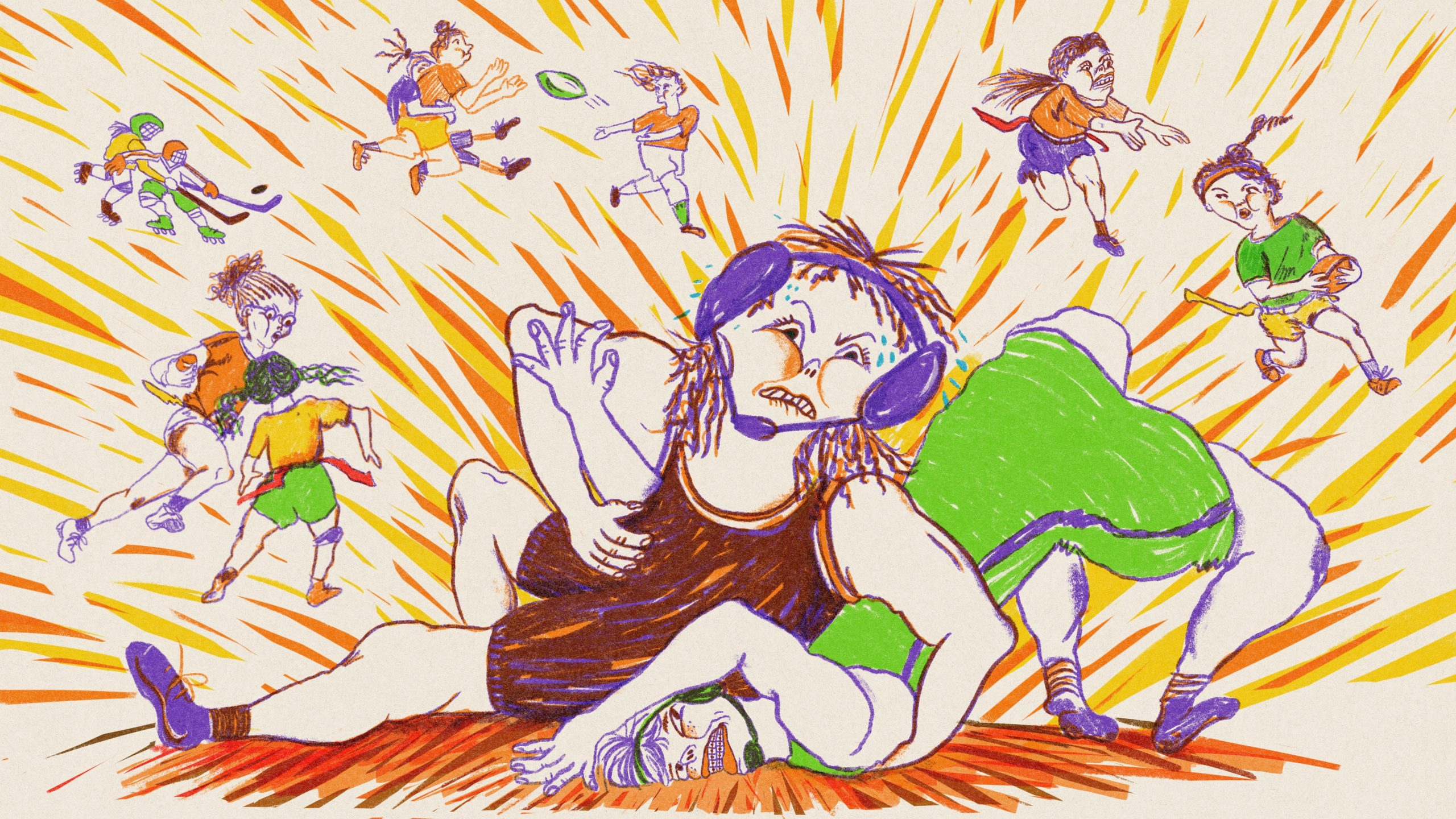
At the turn of the 20th century, a sporty American woman would have had relatively few arenas to test her skill: croquet, maybe, or archery, or basketball played gently in an ankle-length skirt. Public displays of aggression were almost universally condemned, and colliding was especially unsavory. To avoid it, women’s-basketball competitions prohibited “snatching” the ball until the 1960s.
Although men’s and women’s sports generally follow the same fundamental objectives today—stealing the basketball is a smart tactic in anyone’s game—physical contact in women’s sports remains controversial. When Caitlin Clark and Angel Reese exchange elbows in the WNBA, outrage and concern inevitably follow. Meanwhile, NBA players sparring over the ball, or NHL players outright brawling, is typically treated as business as usual.
And yet, girls seem to be more interested than ever in contact. Ice hockey, rugby, and football (of the tackle, seven-on-seven, and flag varieties) are all among the fastest-growing sports for teenage girls. And at American high schools last academic year, more girls played on teams for wrestling than field hockey, gymnastics, or dance.
A high schooler today can join any number of sports teams, including, in some districts, rodeo or bass fishing. Basketball and soccer remain among the most-played girls’ team sports, and typically the first ones that girls play at a young age, Karissa Niehoff, the CEO of the National Federation of State High School Associations, told me. But by high school, not everyone can make the basketball or soccer team, and private leagues can be both competitive and expensive. That leaves a deep bench of untapped players for newer and less conventional sports—bass fishing, yes, but also roller hockey, flag football, and, for girls, sports that traditionally haven’t allowed them to play.
[Read: What’s lost when only rich kids play sports]
Girls’ participation in such sports is growing so quickly in part because it’s starting from a small denominator. But they also seem to offer girls something that traditional options don’t. Some are particularly welcoming to beginners: They take all comers, are relatively affordable, and consume less time than other popular sports. Flag-football games last about 40 minutes—half the time of a typical soccer game—and practice usually precedes the game, making scheduling relatively easy.
Many high-growth sports appeal to a rising cultural sense that women and girls can—and should—bulk up. Girls drop sports at twice the rate of boys, and nearly half cite body-image concerns for doing so. “Thin to win” narratives are still deeply embedded in certain sports, such as long-distance running and Nordic skiing, Nicole LaVoi, the director of the University of Minnesota’s Tucker Center for Research on Girls and Women in Sport, told me. In wrestling, too, competitors sometimes resort to unhealthy strategies to stay in a given weight class. But in flag football and rugby, this preoccupation is largely irrelevant. Flag is about agility; several players I spoke with lift weights to help them achieve faster, more explosive movement. A girl interested in playing football 10 years ago may have been teased for being too masculine, LaVoi said. But the popularity of girls’-football programs today suggests that Americans are more likely to accept that a middle-school girl can be a linebacker.
Flag football, which has seen particularly steep growth over the past five years among teen girls, is technically a noncontact sport, which is part of what makes it appeal to safety-conscious parents of both boys and girls; the NFL started promoting it heavily in the past decade, when youth participation in tackle football was declining amid concerns about concussions. But it is viscerally physical: Players dive for catches and tumble into one another as they pull flags. It’s notable that girls are seeking out this sort of play at a time when so much of adolescent socialization happens over screens. Research from the Women’s Sports Foundation shows that social connection and friendship are the main reasons girls play sports.
[Read: You’ll become a fan of these strange, fierce girls]
Evelyn, a 13-year-old linebacker on a flag-football team in Washington, D.C., told me that flag football’s culture is “nicer” than the culture of the softball, lacrosse, baseball, and swimming teams she’d previously joined and then left. When she joined the flag team, she had an easier time bonding with her teammates, she said. “When I make a good flag pull, my team immediately surrounds me—like I did something good. I did it for my team.” Other sports that put kids in close physical proximity are associated with their own social benefits. For example, a recent study of Turkish adolescent boys found that wrestling may improve psychological resilience, not just because athletes become more physically dominant, but also because the close physical encounters require sustained attention and emotional control, which may promote self-regulation.
Contact sports may lead more girls to play team sports of any kind—something they could benefit from for the rest of their lives. Girls who play sports throughout childhood tend to have better physical health in adulthood compared with those who never played or dropped out. Kids who play sports are likely to experience better mental health, stronger friendships, higher confidence, more positive body image, and superior academic achievement, according to research from the Tucker Center. In a 2014 survey of 400 female corporate executives, 94 percent had played a sport. Sally Roberts, the CEO of the nonprofit Wrestle Like a Girl, credits her high-school wrestling career with setting her up for success elsewhere in life: She was the first in her family to graduate high school and college, and became a three-time national wrestling champion. The growth of more gladiatorial girls’ sports has been successful enough that professional leagues are starting to make long-term investments in them. Several NHL teams sponsor girls’ ice-hockey clinics and camps. In December, the NFL announced it was developing a professional flag-football league for women.
[From the April 2025 issue: Why aren’t women allowed to play baseball?]
Evelyn’s team lost its fall championship in double overtime. But in December, the players were back on the field at a Washington, D.C., middle school. When the game began, Emi, a 13-year-old wide receiver, tumbled toward my feet at the sideline after having her flag pulled. She bounced up and returned to the huddle. Her father explained to me that Emi is naturally very shy, but since starting flag, she’s become more self-assured and comfortable meeting new people.
Later, Emi ran a route, broke free from the defensive back, and caught the ball for a touchdown. Her teammates swarmed her so thoroughly that I couldn’t see her buried under the heap in the end zone.
