
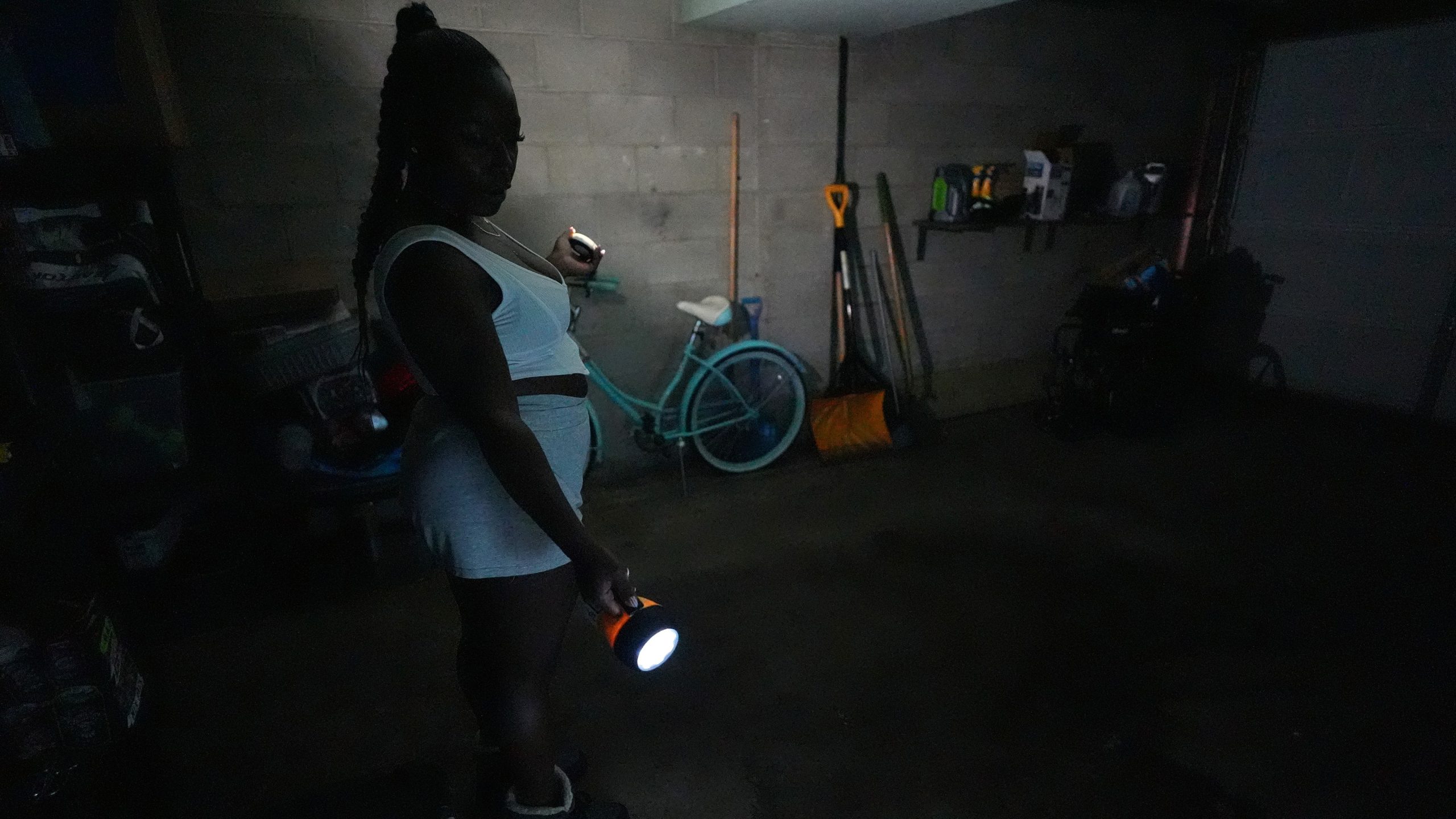
Last night, NIPSCO, an Indiana utility company that provides electricity to half a million people in the northern part of the state, finally made the deadline for restoring power to the city of Gary. On August 11, a derecho swept across northwest Indiana, and winds nearing 100 miles an hour knocked out power for more than 370,000 people, NIPSCO has said. In Gary, home to nearly 70,000 people, 75 percent of them Black, more than half of the utility’s customers lost power in the initial aftermath of the storm. For the next two weeks, NIPSCO kept pushing back its timeline for restoring power; even on Monday, thousands in Gary were still in the dark. As of yesterday evening, the utility said, it had restored power to 99 percent of its customers—which also meant that hundreds of people in Gary still didn’t have electricity this morning.
Blackouts follow plenty of storms, and at a press conference eight days after the storm hit, Gary Mayor Eddie Melton described the ongoing blackout as a situation for “not just Gary” but also all of northwest Indiana. However, as the days of darkness stretched on, and the power started going back in other parts of the region—first Dyer and East Chicago, then Hobart and Merrillville—the initial inconvenience of a Tuesday, a Wednesday, then a Thursday, then a Friday without power started to become a crisis in Gary. This past weekend, Melton was no longer talking about the blackout as a regional problem. Gary, he told me, had not initially been on NIPSCO’s schedule for restoring power and had seemingly been overlooked until the city pushed back.
NIPSCO declined to comment on the specifics of its restoration schedule, but a spokesperson wrote in a statement that it had hired extra contractors and drawn on support from neighboring utilities and that “no outage is being overlooked.”
The people I spoke with in Gary felt differently—that whatever efforts had been made to restore power had not been fast enough. They described throwing out maggot-filled food from their refrigerators, and temporarily moving in with friends and family members who had generators. They were charging their phones in their cars while running the air-conditioning just to stay cool in the summer heat. Gary’s median household income is about $40,000 a year; nearly 20 percent of its people are 65 or older, according to the latest U.S. census data—it’s a community with limited money to spare. People were spending their last dollars on gas to drive through the city on roads without functional streetlights—past uprooted trees, fallen street signs, and loose power lines—just to find supplies.
As the power outage dragged on, relief efforts started reaching the city, but some were first come, first served; others limited relief packages to one per household, which kept people from picking up extra care packages for neighbors stuck at home. “Our seniors are stuck in their apartments, completely dark,” Willett Wright, a 77-year-old resident who was still without power, told me. “There’s no generators in the world that can get up to their apartments. They’re stuck in their rooms with all this heat, and no food.”
Power slowly began to come back this weekend, but not across all of Gary’s neighborhoods. Some residents were still waiting in the dark. And even in the places where power had come back on, the lights were still flickering. If you ask Gary residents what time their power was turned back on, they can share it almost down to the minute: 11:32 p.m. on Saturday; just after midnight on Sunday; 2:45 p.m. on Monday.
Indiana is used to dealing with some types of severe storms, which were responsible for nearly 50 percent of the major disaster costs in the state over the past 44 years, a 2025 report from the National Oceanic and Atmospheric Administration found. But this derecho—a strong windstorm that moves in straight lines and can be as fast as a hurricane or a tornado—felt different, residents told me. Climate change is contributing to a steady increase in storm frequency and severity across the United States, which is in turn increasing damage to power grids across the country, Kyri Baker, a University of Colorado at Boulder associate professor who focuses on power systems and power-grid resilience, told me. “A lot of the extreme weather events are happening in areas that we didn’t initially expect,” she said. “Utilities need to change their game plans in preparing for those low-probability events.”
Gary’s problems with infrastructure were clear long before the storm rolled in. Over the past decades, as deindustrialization has shrunk the city’s population and tax base, its infrastructure has crumbled too. NIPSCO has a monopoly on Gary’s electricity, and a 2025 analysis by the Citizens Action Coalition, a consumer-advocacy organization, found that NIPSCO customers were already paying the highest bills of any of Indiana’s five investor-owned electric utilities; last year, NIPSCO was approved for another rate increase to upgrade power lines and technology updates. Even though low-income Black households tend to spend more of their incomes on utilities, they are disproportionately affected by electric-grid failures and face slower restoration times after extreme weather events. (NIPSCO did not respond to questions about its infrastructure investments or its rates.)
Each day that the lights stayed off added to the disruption in people’s lives. David Rucker and his wife, Tiffany, told me that they’d had to drive about an hour every day to Chicago to charge his BiPAP ventilator, which he needs to breathe when he sleeps. The device runs only four hours when it’s battery-powered. Although Gary is only about 30 minutes away from the south side of Chicago, the journey takes twice as long, because their car’s transmission needs to be fixed. “The money we would’ve spent to fix it, we don’t have,” Tiffany said. “Now everything is depleted. The storm has taken a lot—mentally, physically, and monetarily.” Their power was restored on Monday night at 10 p.m.
As the power comes back on, people are ready to restock and return to a sense of normalcy. They are refilling insulin prescriptions that went bad in warm refrigerators, recharging glucometers, and getting wellness check-ups for high blood pressure and A1C levels, practitioners at Gary’s NorthShore Health Center said. Several people I spoke with said that they are cautiously refilling their refrigerators with groceries, and stocking up on batteries in case of another emergency. Earlier this week, Indiana Governor Mike Braun requested an investigation into NIPSCO’s tree maintenance, as well as a review of approved state funds for the city’s infrastructure. Yesterday, President Trump approved a major-disaster declaration for Indiana, allowing FEMA aid to help the state recover from the damage. The city is finally getting some of the attention and help it has long needed.
