
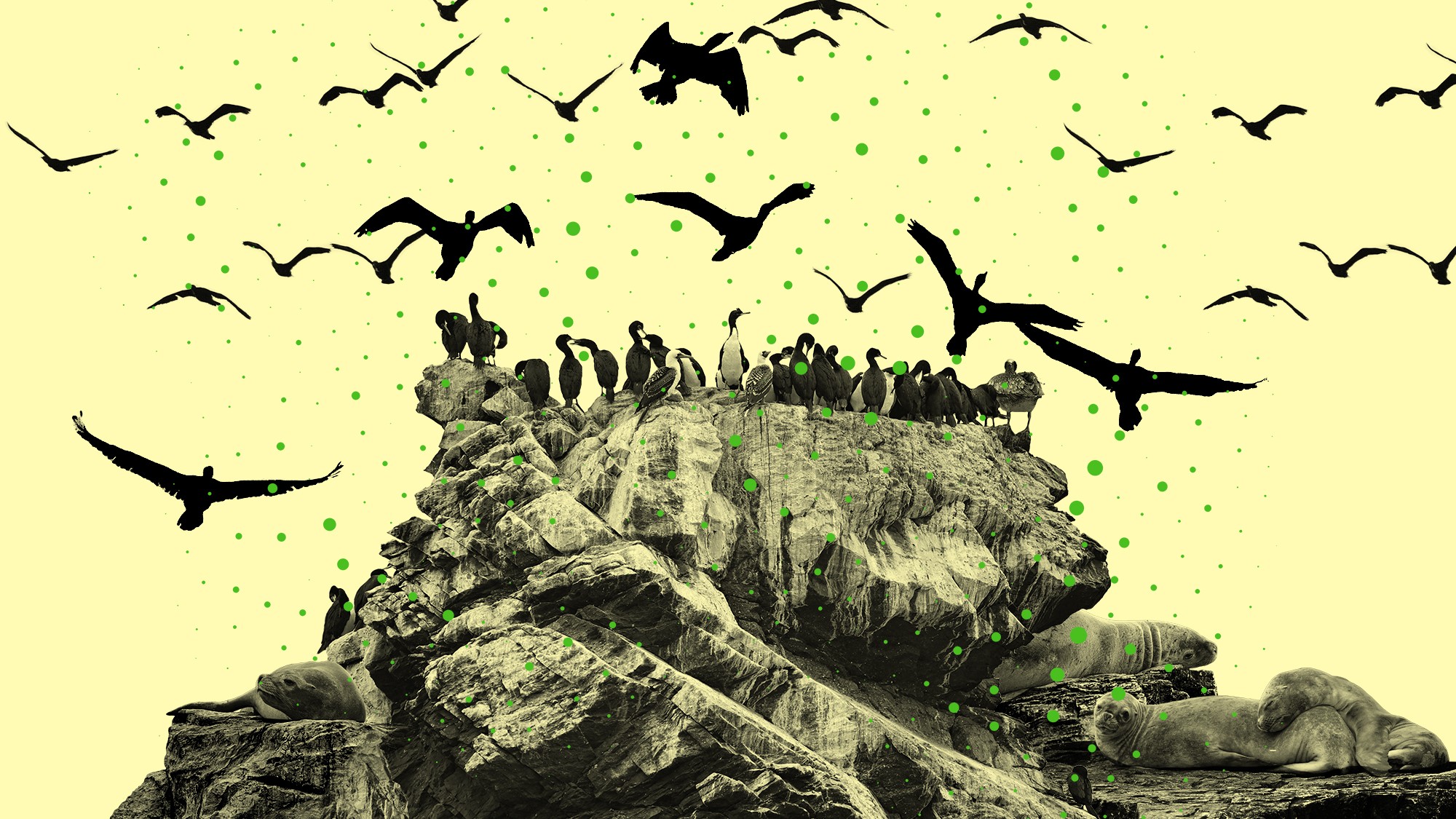
You have likely never heard of synanthropes, though you surely know them. And they know you. Synanthropes, whose name is derived from the Greek for “together with man,” are not our pets or our herds of domesticated animals but something like our oldest frenemies: beings from which we have long sought and failed to decouple ourselves, that now reside within our communities, and that have become an ineluctable part of our lives. They include insects like bedbugs, which have evolved within urban environments to become uncommonly dependent on humans for their survival, as well as house sparrows, seagulls, blackbirds, and pigeons, all of which have adapted themselves to take advantage of cities while evading their dangers. In Singapore, synanthropic river otters have begun rampaging through local markets and aggressively pursuing tourists for food. Black bears are bathing in backyard swimming pools in California.
All of these creatures straddle the human world and the wild. And that can make them uniquely perilous to human health.
In Chile, which has a 4,000-mile-long coastline, the most conspicuous synanthrope is the South American sea lion. About 130,000 of these pinnipeds, which can weigh 660 pounds and resemble giant waterlogged chocolate Labrador retrievers, live in raucous colonies on the water’s edge. On account of their ubiquity, pretty much everyone in Chile has had some kind of run-in with the barking beasts.
“As a Chilean, you can easily see sea lions,” Victor Neira, a veterinary scientist and virologist, told me from his lab at the University of Chile in Santiago. Sea lions have long been habituated to human handouts in Chile, and many of the urban colonies they’ve established are located near fish-processing plants, where the animals gorge on fish guts, bycatch, and other detritus dumped back into the ocean. “They’re not aggressive by nature,” Neira said. “They see people all the time, so they generally just move out of the way for you.” He thought for a second and seemed to change his mind. “That being said, if you mingle with them, they will try to bite you. So usually you have to kind of run or you have to scream.”
Neira has had more than his fair share of sea-lion encounters, because he’s spent the past decade tracking novel viruses in wild and domesticated animal populations across South America to sound the alarm about potential threats to humans. The more blood and fecal samples he and his team collect from seabirds and marine mammals, the more likely they are to detect novel pathogens or viral variants that have just appeared in the region. This sort of epidemiological research is undertaken in countries across the world because scientists now recognize that synanthropes are among the most important vectors transmitting novel pathogens to human populations. The hope is that a network of scientific early-warning systems, like the one Neira and his team have designed, can give humanity a head start in identifying new pathogens and stamping them out before they explode into the next pandemic.
In December 2022, Neira discovered a disturbing anomaly in blood samples he had been routinely collecting from migratory birds in Chile. H5N1—an influenza virus that causes acute respiratory symptoms and death in birds—appeared to be circulating among pelicans, cormorants, and terns. All three species regularly cross paths with other birds and sea creatures, and the viruses they harbor, along their migration routes. Neira was terrified. In the preceding 20-plus years, H5N1 had killed tens of millions of wild birds around the world, and hundreds of millions of poultry had been culled to contain its spread. He girded himself for a devastating avian outbreak. When the viral wave arrived, though, the casualties went much further.
Neira told me that in early January 2023, clusters of dead seabirds began washing up on shore. Later that month, Neira’s team witnessed the first cases of H5N1 among Chile’s sea-lion colonies. After years during which the monthly number of sea lions stranded on land (a measure that marine biologists use to assess disease severity and death counts) never surpassed 100, January 2023 saw a sudden spike to about 250. One month later, that number had doubled, and in June, more than 4,500 stranded sea lions were observed by scientific authorities. Overall, somewhere between 10 and 25 percent of the sea-lion population in the country died in the six months after the first H5N1 case was detected among Chilean seabirds, though Neira estimates that the proportion could be double that. It was a sudden and deeply frightening mass-mortality event, caused by a virus that had gained the ability to infect and kill mammalian hosts as well as avian ones. The corpses were piling up on shore, attracting flies and other scavengers—and risking further spread of the virus. Eventually, Neira said, the Chilean government built halls to house the remains, a sign of the scale of the crisis and its lasting impacts on Chile’s ecosystem.
More epidemics were caused by novel viruses in the past two decades than in all of the 20th century, suggesting that human vulnerability to opportunistic pathogens has shifted dramatically. The H5N1-fueled mass-mortality event among Chilean sea lions is an unsettling illustration of how synanthropes are ratcheting up this risk by bringing novel viruses carried by wild and migratory animals close to humans. H5N1 is still spreading through animals worldwide, including in the United States. More than 1,000 American dairy herds have tested positive for H5N1 over the past two years; cases among poultry and cattle alike may tick up this fall during the seasonal migration of wild birds.
So far, that hasn’t translated into a major human outbreak. Since 2024, only 71 human cases of H5N1 have been reported in the U.S. Two people have died. No evidence indicates that the virus currently infecting cattle can spread between people. It’s a lucky break, given how ubiquitous H5N1 is among hundreds of wild bird species that regularly come in contact with poultry and cattle herds, which are perfectly positioned to infect human populations with opportunistic pathogens. That luck might not hold forever, though. A recent report from the World Health Organization suggests that H5N1 viruses are continuing to mix and match genetic material, and a 2024 study from Scripps Research Institute in San Diego found that the H5N1 variant circulating in U.S. cattle is only a single amino-acid mutation away from being able to efficiently infect humans.
As animal populations continue to come into closer proximity with humans, the threat posed by synanthropic viruses will only grow. Viral pathogens can now be efficiently borne from the most remote places on Earth into the heart of human metropolises. It just takes an animal to bring it from there to here.
This article has been adapted from Dan Werb’s new book, Our Wild Familiars: How Animals Are Adapting to Cities and Reshaping the Natural World.
