
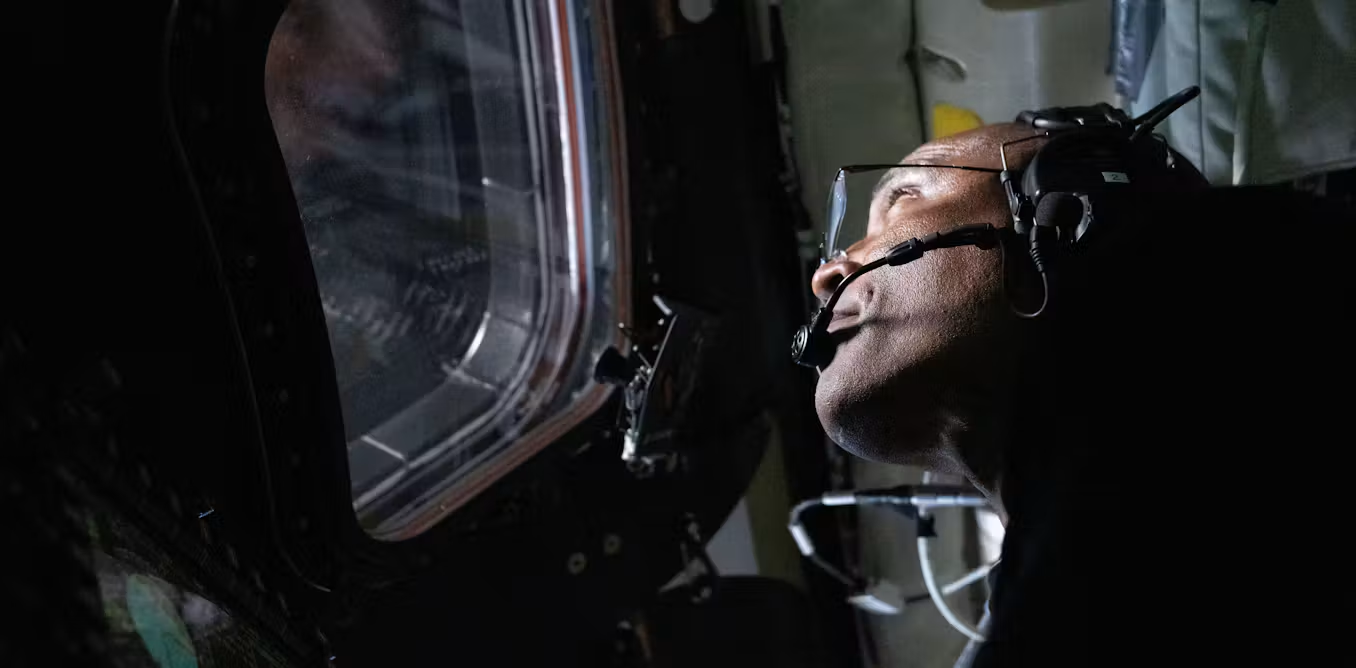
For most people on Earth, the rhythm of life is dictated by a predictable cycle of sunrise and sunset. Our bodies have evolved to synchronize with this twenty four hour loop, using light as the primary signal to decide when to wake up and when to wind down. However, for astronauts orbiting the planet, this reliability vanishes. Because a spacecraft circles the globe roughly every ninety minutes, crews experience sixteen sunrises and sunsets in a single day. This chaotic environment turns spaceflight into a massive biological experiment, revealing the delicate tension between feeling tired and actually being biologically ready for sleep.
Researchers distinguish between sleep pressure, which builds up the longer we stay awake, and the circadian clock, which tells the brain if it is currently daytime or nighttime. In space, these two systems often clash. An astronaut might feel physically exhausted but find themselves unable to drift off because their internal clock insists it is midday. While NASA attempts to mitigate this through strictly timed meals and specialized artificial lighting designed to mimic Earth’s cycles, getting enough rest remains elusive. Despite being allotted over eight hours of sleep opportunity, many astronauts average only six hours per night, leading to chronic sleep restriction that impairs their ability to react quickly to critical information.
Managing sleep in orbit involves complex engineering trade offs that affect everything from mood to safety. For instance, dimming lights to encourage melatonin production can make it difficult for astronauts to distinguish color coded buttons or warning signals on their consoles. Even common fixes like caffeine act as a double edged sword; while coffee keeps a pilot alert during a midnight crisis, it often sabotages the quality of the few hours of restorative sleep they manage to get later. To combat this, scientists are experimenting with tools like pink noise headbands to see if auditory stimulation can enhance alertness after short naps.
As humanity looks toward deeper space exploration, the challenges grow even more peculiar. On Mars, a single day known as a sol lasts twenty four hours and forty minutes. While an extra forty minutes seems negligible to a casual observer, it represents a persistent misalignment for the human body over long periods. Current simulations at the Johnson Space Center are testing how crews handle this shift in timing, proving that success on other planets depends less on rocket fuel and more on our ability to master the invisible clocks ticking inside our own heads.
