
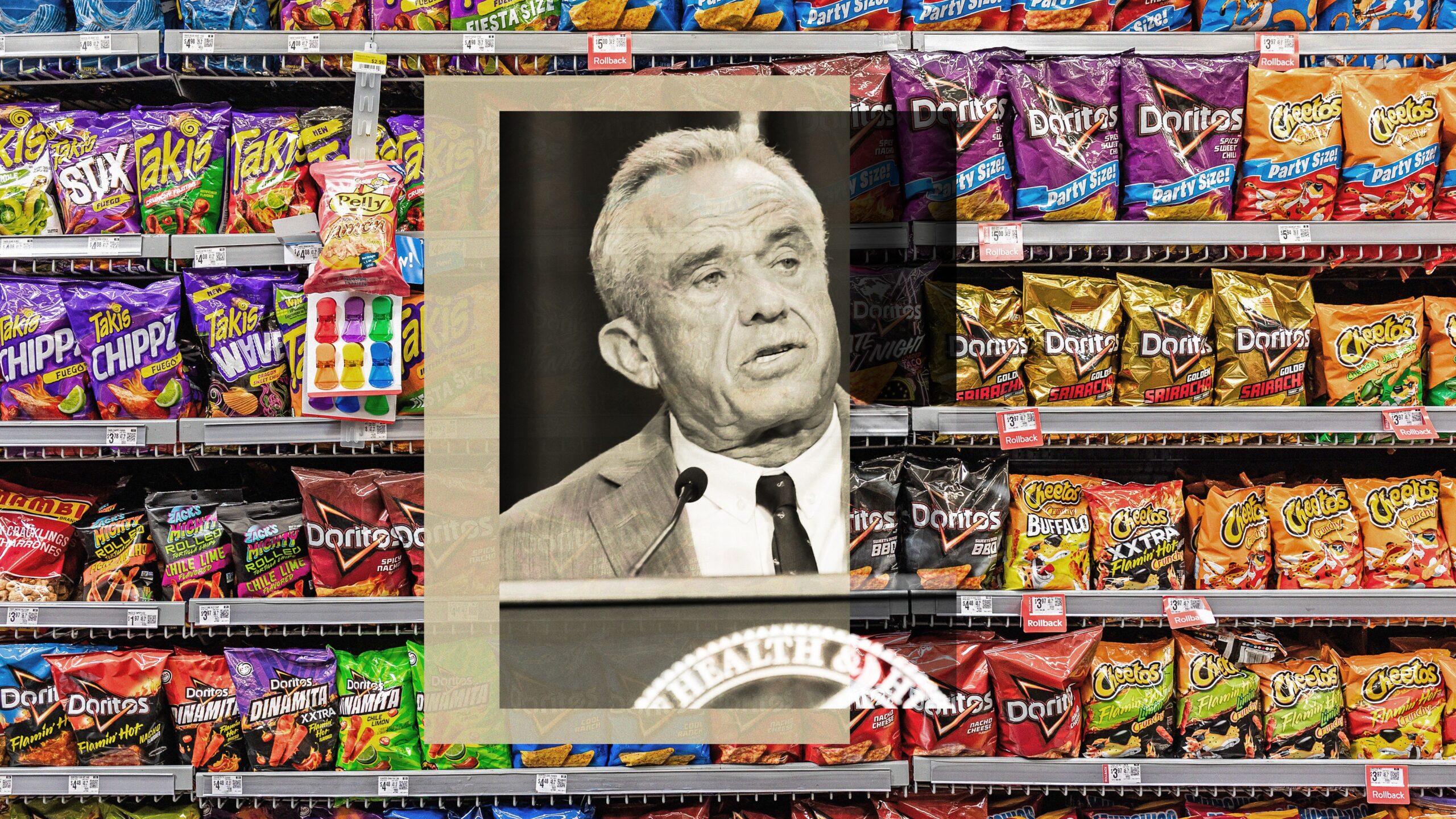
In early August, Robert F. Kennedy Jr. staged a “policy celebration” at the Department of Health and Human Services headquarters to give an update on one of his signature initiatives: a new definition of ultra-processed food. Publishing the definition would be the first step toward achieving several “Make America Healthy Again” goals, such as new front-of-package labels to steer consumers away from unhealthy foods and, eventually, a reduction in preventable disease. But even as Kennedy was planning the festivities, a months-long bureaucratic battle was threatening to derail it.
Days before the planned event, senior staff at the White House told Kennedy’s team that the definition would need to stay secret because it had not yet cleared a review process at the Office of Management and Budget. That review had become a major point of contention. Some inside the administration wanted more data on the economic effects of policies that could follow from the definition; others insisted that the delay was unnecessary and political. When Kennedy took the stage, flanked by children holding Eat Real Food posters, he could announce only that an announcement was still coming.
This dispute over regulatory language has since helped unravel the team that cemented the MAHA-MAGA alliance and has guided Donald Trump for years. Less than two weeks before the midterms, a Kennedy ally named Calley Means quit his job at the White House in protest. White House Chief of Staff Susie Wiles then mounted a new effort to release the definition before the election, only to have Kennedy pause it. On the same day that Wiles announced her resignation following a poor Republican showing in the midterm election, Means appeared on Joe Rogan’s podcast to accuse her of caving to the food industry. Inside the White House, some staff were outraged. One White House official that day called Means a liar and a failure who “confuses his own inability to persuade with others’ malfeasance.”
Now, under the new regime of Chief of Staff Stephen Miller—who has long claimed his own special affinity for MAHA—the ultra-processed-food language, a draft of which we obtained, is once again moving forward. According to several people with knowledge of the plan, HHS has been preparing again for a long-awaited release of the definition, which is expected as soon as next week. (When asked for comment, HHS directed us to the White House, which sent a statement that listed past MAHA accomplishments and declared, “Stephen Miller and Secretary Kennedy have been working closely together since day one, and they will continue advancing bipartisan MAHA victories.”)
The story of the conflagration at the White House, which involves Trump-administration staff trading accusations of corruption and incompetence, is based on interviews with eight current and former officials involved in the process, most of whom requested anonymity to describe conversations that occurred behind closed doors. The dispute exposed major divisions within the White House over how far to take Kennedy’s Make America Healthy Again agenda. Now the future of the UPF definition will signal whether the alliance between MAGA and MAHA can survive.
The government’s proposed definition of ultra-processed food has remained largely unchanged since a team led by then-Food and Drug Commissioner Marty Makary first drafted it, in the summer of 2025, according to people close to the process. In about 200 words, it classifies as ultra-processed any food or drink containing a chemical preservative, artificial color, added flavor, or low- or no-calorie sweetener such as stevia and aspartame. Additives intended to thicken foods or otherwise alter their texture, such as guar gum and sodium alginate, will also land a food on the UPF list.
The definition relies heavily on existing federal regulations that spell out what, exactly, qualifies as a color, sweetener, or other additive. It excludes infant formula, dietary supplements, and foods that qualify as “healthy” under an FDA standard that sets limits on added sugar, sodium, and saturated fat. (Those products also must contain minimum amounts of healthy ingredients such as fruit and whole grains.) Even with those exceptions, experts we spoke with said, the definition of an ultra-processed food would likely cover most packaged products on grocery-store shelves—not just classic junk food, like cheese-filled pretzel bites, but also many flavored yogurts, instant oatmeals, and protein bars. Most packaged breads, which contain additives that prevent mold and maintain softness, would go on the list too.
That’s a frightening proposition to the food industry. The Consumer Brands Association, which represents some of the country’s largest food and beverage manufacturers, including PepsiCo and Tyson Foods, argues that the suspected harms of UPFs—obesity, cardiovascular disease, diabetes, cancer—have not been confirmed by strong scientific evidence. It’s true that the science on UPFs, including which ingredients or processes might make them unhealthy, remains unsettled. But nutrition experts told us that enough evidence links them to poor health outcomes that consumers should be warned.
That prospect—that the UPF definition will lead to new regulations and legal actions—has been the crux of the fight inside the administration. Kennedy has advocated for new front-of-package UPF labeling that would be similar to cigarette warnings. The Consumer Brands Association has argued that such a requirement would place an undue burden on food manufacturers. The association has touted a recent study by University of Chicago economists predicting that a mandatory label would prompt food companies to spend billions to reformulate their products, raising the average household’s annual grocery bill by $60. But several nutrition experts we spoke with questioned the study’s assumptions. Lindsey Smith Taillie, a nutritional epidemiologist, told us that companies are “reformulating and changing their packaging all the time” and still manage to bring in billions in profit. In fact, some companies have done so recently as part of Kennedy’s push to remove artificial dyes from the American food supply. So far General Mills has voluntarily dropped them from cereals sold in the United States, and Kellogg says it plans to ship reformulated Froot Loops and Apple Jacks by year’s end.
Food companies are also concerned that a federal definition might be used in litigation. In the past two years, consumers, as well as the city of San Francisco, have sued major food companies over alleged harmful health effects, and advocates hope that a new definition could make their cases more credible. One attorney, John Morgan of Morgan & Morgan, has been especially active in these suits; his firm previously collaborated with Kennedy on an environmental case and maintained a working relationship with him until he became health secretary. That connection “does raise questions in our mind” about Kennedy’s motivations, Rhonda Bentz, a spokesperson for the Consumer Brands Association, told us. Morgan told us that he doesn’t need a new federal definition to help him make a case against food companies, but did not rule out incorporating one. “Their defense is always the same one,” he told us. “It’s deny, delay, deny, delay.”
Given how vehemently the food industry opposes these measures, some drama over a government UPF definition was inevitable. But at the beginning of the second Trump administration, the two people at the center of the fight nonetheless believed that they could find a solution. Besides Trump and Kennedy, Means and Wiles were the most significant players in the unlikely merger of MAHA and MAGA. Wiles had reached out to Means in 2023 after reading his ideas about public-health reform, and Means first connected Kennedy to Trump. In the weeks that followed, Wiles led the negotiations to merge the Kennedy and Trump campaigns. “Susie Wiles is the best choice of chief of staff for MAHA,” Means posted on X in November 2024, when she was named to the post. In 2025, Wiles green-lighted an aggressive series of reports and announcements in which Kennedy put forward his plans to define ultra-processed food, redesign the food pyramid, and review school and military meals.
But Wiles also established a policy process that rankled Means and his allies, allowing different Cabinet departments—as well as lobbyists and industry leaders—to weigh in on changes. “Susie wanted to get to yes, but we had to do it in a way that doesn’t endanger the U.S. food supply,” a government official involved in the policy discussions told us. Means came to believe that the process was just an excuse for further delay, he told us. “The problem with Susie’s leadership was there was no process, and special-interest phone calls were able to delay or kill key priorities that the president ran on,” he said. (Wiles declined to comment for this article.) Kennedy’s staff frequently clashed with farmers, food producers, and Department of Agriculture staff. As we reported in July, MAHA activists inside and outside the administration had become especially frustrated with Heidi Overton, a medical doctor and White House policy adviser, who often slowed down health-policy changes to refine them. Wiles vocally defended Overton and the process at the time, telling us that the White House was focused on making sure “things are correct, legally durable, done with policy consistency.” (Trump nominated Overton to be FDA commissioner in August, but withdrew that nomination earlier this week.)
By late last summer, officials at HHS believed that the UPF definition was ready to go. But at an interagency gathering this July, Means was peppered with questions about what the new definition would mean for food prices and the liability of food producers, as well as whether it would be vulnerable to legal challenge, according to people familiar with the meeting. For his part, Means warned other officials that they would be seen as catering to industry interests if they did not embrace the definition, which had then been circulating inside the administration for about nine months. Wiles’s team later insisted that the concerns raised at the meeting had not been addressed. The fact that Republicans were being hammered in campaigns across the country for the rising costs of food also weighed on the White House.
Backers of the UPF definition viewed such complaints as stonewalling and were concerned that the delay would endanger their ability to get regulations such as new food labels in place before the end of Trump’s term. “It was two pages,” another person involved in the policy discussions told us. “The idea that you have to do some complex policy process for a two-page proposal is laughable.” Means told us that hundreds of meetings were held to discuss the definition, and he stopped believing that the White House would release one before the election. So he quit.
When Means appeared on Rogan’s podcast, he alleged that Wiles had told him that she had concerns about a separate MAHA-coded effort—this one to regulate additives—because Republicans needed money from the sugar industry for the midterms. Allies of Wiles denied that she ever said this, and people who worked with her pointed out that the sugar industry ranked low among top donors to Republican election efforts. The day after his Rogan appearance, Means invited Wiles to sue him.
After Means left the White House, Wiles and Kennedy started working again to release the UPF definition so that it could receive public comment before being finalized next year. In the week before the election, the White House and Wiles cleared a version of the definition, including a preamble specifying that it should not yet be used in litigation or for shaping legislation. Then, just days before the election, Kennedy decided that the process was too rushed and opted to wait to announce the language until after the election. The definition that is set to be released now is not expected to be materially different, people involved in the process told us.
Kennedy has also carefully kept some distance from the controversy. After Means denounced Wiles as corrupt, Kennedy praised her “inspiring leadership and wisdom” in a post on social media. Trump—who has at times sounded even more aggressive than Kennedy on some MAHA issues, especially those related to childhood vaccines—has remained silent. The White House has not yet announced whether the president will be involved in the release of the new ultra-processed-food standards.
Following Means’s departure and the Republicans’ midterms disaster, some pundits were ready to write off MAHA entirely. The unlikely coalition appeared to be fraying, its supporters were demoralized, and most of the candidates backed by its political-action committee lost their race. But MAHA’s obituary may turn out to be premature. A federal UPF definition would be Kennedy’s most tangible win yet, and a sign that MAHA might still have some life left. Assuming, that is, it finally gets published.
