
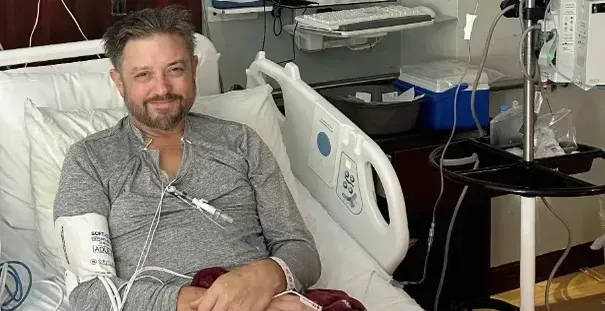
Ryan Goepel originally believed a persistent ache in his knee was simply another bout of gout, a condition he had struggled with in the past. However, when a routine visit to his doctor revealed that his immune system had virtually vanished, the situation shifted from a minor inconvenience to a medical emergency overnight. Upon arriving at the hospital, Goepel was stunned to find an oncologist waiting for him with a devastating diagnosis of acute myeloid leukemia. His condition was so critical that doctors privately advised his partner to begin making hospice arrangements, believing he would not survive.
Refusing to accept defeat, Goepel and his partner sought a second opinion at the Sylvester Comprehensive Cancer Center in Miami. There, specialists discovered that his form of AML carried an adverse-risk genetic profile, meaning traditional chemotherapy would likely fail and could even accelerate his decline. In a stroke of extraordinary timing, Dr. Justin Watts had one remaining spot in a clinical trial testing a combination of medications usually reserved for much older patients. Desperate to survive and determinedly writing in his journal that he was not done yet, Goepel jumped at the chance.
The response to the experimental treatment was nothing short of miraculous. Within just two weeks of starting the regimen of pills and infusions, Goepel entered remission. He was part of a larger success story within the trial; data eventually showed that nearly two thirds of participants saw their cancer shrink or disappear, far outpacing the effectiveness of standard treatments for high-risk patients. This breakthrough has since prompted oncologists to question whether long standing protocols for treating aggressive leukemias need to be fundamentally rewritten.
While the trial halted the immediate threat, Goepel still faced a grueling road toward permanent recovery through a bone marrow transplant. Thanks to perfect matches found among his sisters, he underwent the procedure in late 2024. After months of isolation and battling post-transplant infections like pneumonia, tests now confirm that the transplant is working. Reflecting on his journey from the brink of death back to health, Goepel attributes his survival to a whirlwind blend of persistence and being in exactly the right place at the right time.
