
For decades, the global industry has relied on the belief that common plastics like polyethylene and polystyrene are chemically inert. This perceived stability is precisely why they are so useful for everything from food packaging to medical devices; they simply do not react with their surroundings under normal conditions. However, a groundbreaking study is now challenging this long held paradigm, suggesting that once these materials break down into microscopic fragments, they cease to be passive bystanders in the environment.
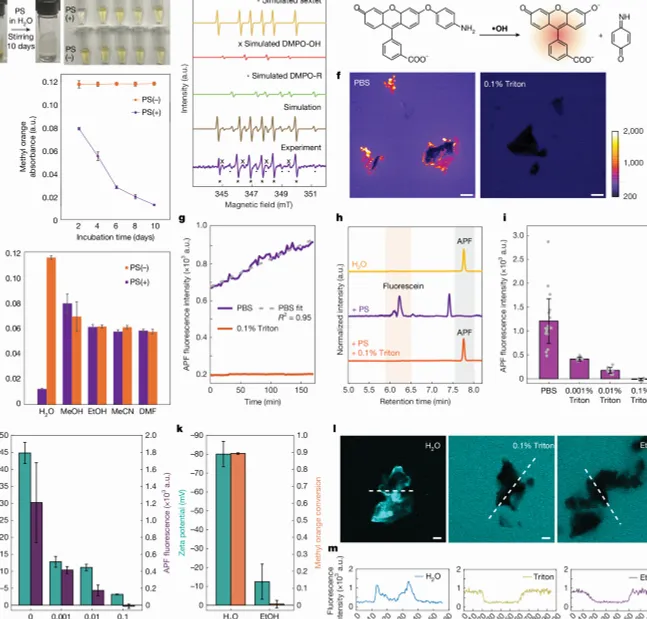
Researchers have discovered that microplastics possess an intrinsic physicochemical activity specifically at the point where the plastic meets water. While a large block of plastic might remain dormant, fragmentation drastically increases the surface area relative to volume. This shift creates a volatile interface where something unexpected happens: the spontaneous generation of hydroxyl radicals. These highly reactive molecules can act as chemical catalysts, triggering reactions that would never occur in bulk plastic or even in pure water alone.
To prove this phenomenon, scientists tested polystyrene microplastics in water containing methyl orange, a sensitive azo dye. Despite polystyrene being renowned for its chemical resistance, the researchers observed a steady degradation of the dye over ten days until the solution became nearly colorless. Crucially, this reaction occurred only in water and not in other solvents, indicating that the unique interaction between hydrophobic plastic surfaces and water molecules is what drives this hidden reactivity.
These findings provide a potential missing link in explaining why microplastics are linked to serious health issues, including inflammation and cellular damage within human bodies. If these tiny particles are actively generating oxidative stress through radical production, they could be chemically modifying biomolecules and damaging cells upon contact. What was once thought to be an inert piece of debris may actually be functioning as a miniature chemical reactor moving silently through our ecosystems and bloodstream.
