
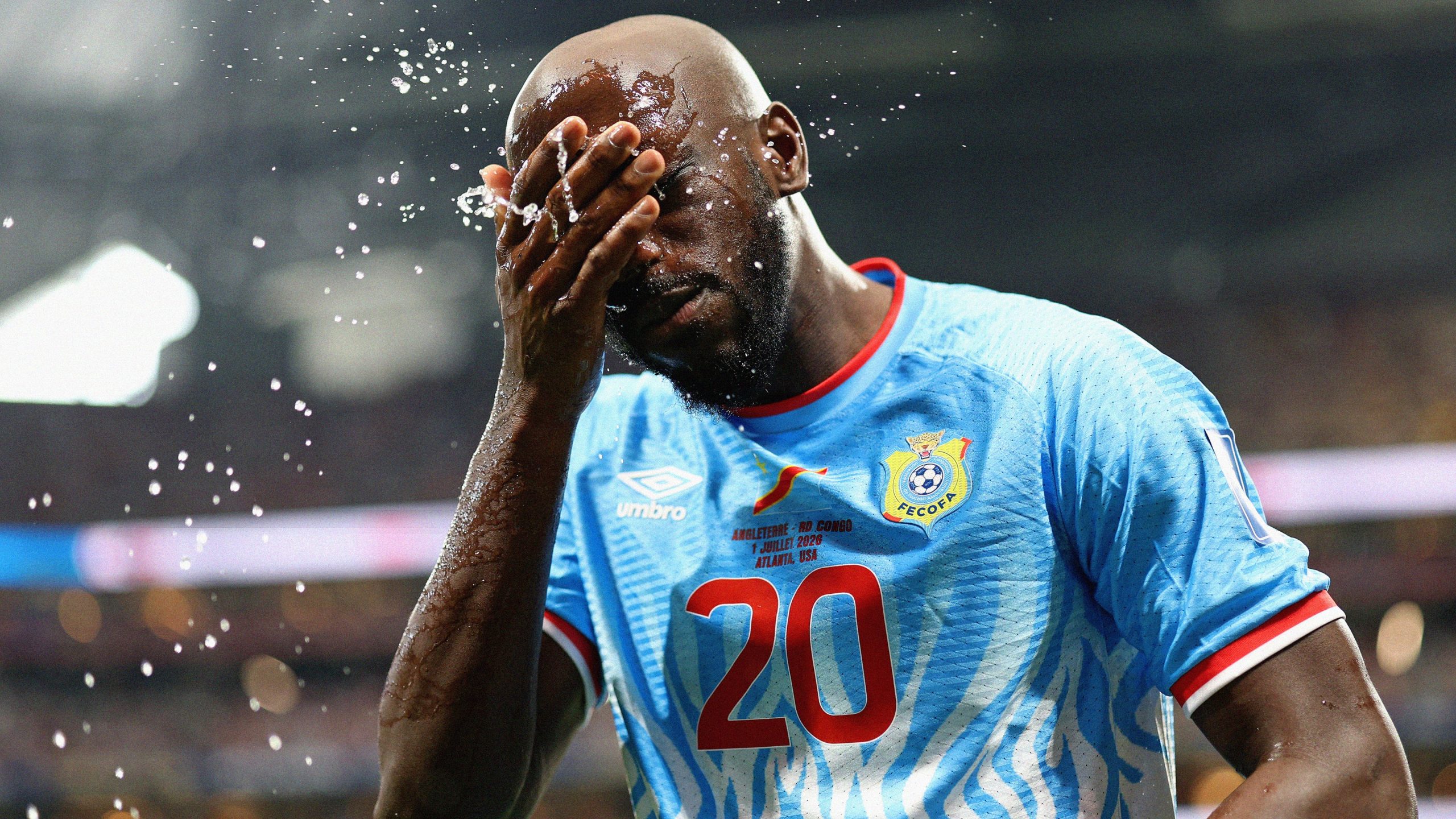
Last June, England’s men’s national soccer team went to Spain for a training camp. Next to the pitch were tents artificially heated to a minimum of 95 degrees Fahrenheit, where players completed fitness tests on exercise bikes while staff measured their performance. Each player swallowed a biometric tablet, about the size of a large vitamin, so that scientists could see how well his body cooled itself. At the time, England’s head coach, Thomas Tuchel, told reporters, “I will be very surprised if we do not suffer” at the 2026 World Cup in North America, where his athletes would be tested not just against other teams but against the hot and humid summer.
The weather in the United States in the coming days will provide such a test—for World Cup athletes and for millions of Americans alike. The heat wave sweeping across the country will hit several World Cup locations, including New Jersey, Kansas City, and Philadelphia, where stadiums lack roofs and air-conditioning. The last time North America hosted the World Cup, in 1994, games were infamously hot, and this tournament could give it a run for its money. Tomorrow, temperatures in Kansas City, Missouri, are expected to reach into the 90s, and they’ll get close to 100 in Philadelphia when the city hosts a game on Saturday. Both cities have been placed under extreme-heat warnings by the National Weather Service. If we mere mortals are made miserable by the heat, these footballers will be miserable and vigorously exercising—they usually run about seven miles during a game, Orlando Laitano, a professor of applied physiology and kinesiology at the University of Florida who works with Brazil’s national team, told me.
For months, teams have strategized about how best to prepare their athletes for this kind of heat and humidity—with post-training saunas, hot-water immersion, sweaty outdoor workouts, and heat-training camps. In an ideal world, athletes would spend about 15 days working out in the heat to get used to a region’s climate in the lead-up to the tournament, Lee Taylor, an exercise and environmental physiologist at Loughborough University who consults with several soccer teams competing in the World Cup, told me. Many teams try to do exactly that. Norway’s squad—probably especially in need of some heat training—went to Greensboro, North Carolina, where, at one point, it got so hot that the coaches reportedly cut practice short. Brazil’s team, meanwhile, decamped to Orlando, Florida, where Laitano affixed players with sweat-collection patches and analyzed their fluid and electrolyte loss during workouts to concoct a hydration regimen for each person.
But many players get less than 15 days of acclimatization time. Although England’s team held a 10-day training camp in Miami ahead of the World Cup, some players arrived late because they were busy with the Champions League finals. Laitano still ruminates over Brazil’s loss in the 2014 World Cup, which the country hosted not long after he started working with the team. Brazil chose to train in the mountains of Rio de Janeiro, a region that, during the Southern Hemisphere’s winter, was colder than the other parts of the country where they’d be playing, he told me. Germany, which won the tournament, trained in Brazil’s sweltering state of Bahia. “I can’t say they won only because they stayed in the heat,” Laitano said, “but they did choose to have their base in a hot environment, because they knew it could be an edge for them.”
Acclimatized or not, players are still dragged down by the heat. Research has shown that athletes generally don’t play as intensely during hot matches—not sprinting as often, for instance—and just as a heat wave can zap a person’s energy over multiple days, the fatiguing effects of heat accumulate during the tournament. Still, trainers have a few tricks that can help athletes—or anyone, really—withstand the heat. To lower their core body temperature, athletes might don an ice-filled vest (admittedly, not a household item) or, before a match, dunk themselves in an ice bath (easier to try at home). FIFA has mandated periodic hydration breaks throughout this year’s games, too, during which players can drink ice slurries and wrap themselves in cold towels. (Again—not a bad idea when air-conditioning leaves something to be desired.)
For those of us who haven’t spent months preparing for heat under the care of dozens of experts, the options are somewhat limited. People take about eight to 10 days to get well acclimated to heat, Michael Sawka, an exercise physiologist and heat-adaptation expert at Georgia Tech, told me. When heat waves come on suddenly, people have little chance to acclimatize, and many of the areas affected this week, such as New York City, have had fairly reasonable temperatures recently, Carol Ewing Garber, an exercise physiologist at Columbia University’s Teachers College, told me. Most people will just have to get through it. Garber suggests that those of us not competing in the World Cup follow a few basics: In lieu of a mandated uniform, we should wear breathable clothing; entire nations are not fiercely anticipating our performance on a soccer pitch, so we can choose to spend time in the shade and to exercise in the cooler hours of the day. And on one count, the advice is the same for both normies and World Cup players: Take frequent water breaks.
